
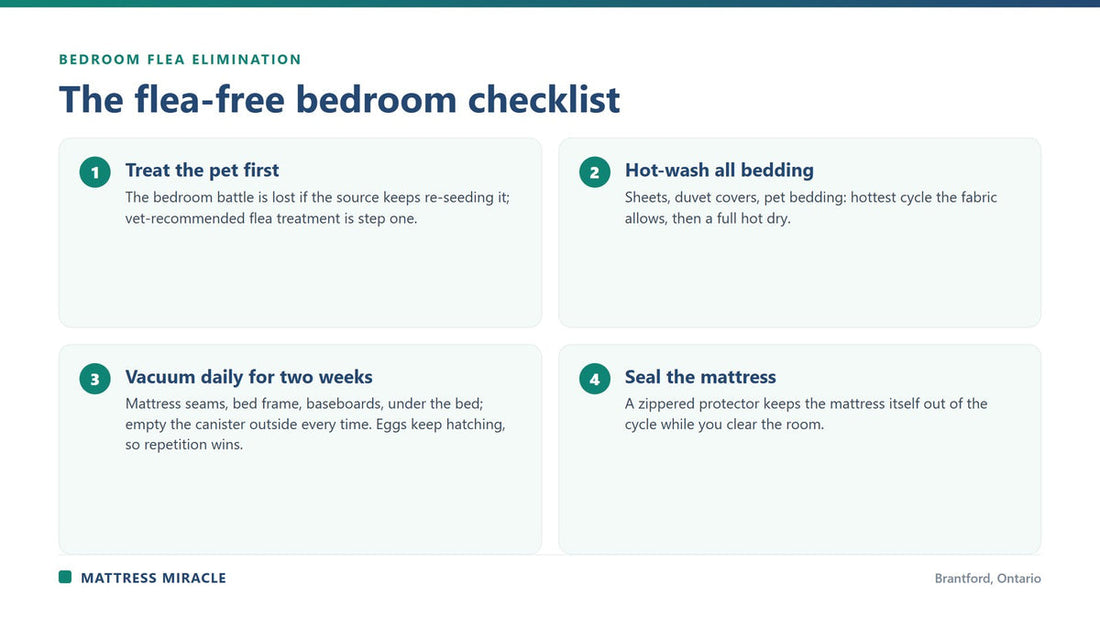
Quick Answer: To get rid of fleas in your bedroom, wash all bedding in hot water (60°C or higher), vacuum every surface thoroughly, treat carpets and mattress with a flea-killing spray or diatomaceous earth, and apply a preventive treatment weekly for four weeks to break the flea life cycle completely.
In This Guide
13 min read. Updated September 17, 2026.
Our bed worms guide covers the other larvae people find in bedding.
Finding fleas in your bedroom is unpleasant enough. Finding flea bites on your ankles when you wake up is worse. The good news is that with a systematic approach, you can clear them out and keep them gone. The bad news is that half-measures do not work. Fleas have a life cycle that lasts weeks, and if you only treat adults, the eggs and larvae will hatch and start the whole thing over again.
At Mattress Miracle in Brantford, we hear from customers fairly regularly about flea concerns on their mattresses. This guide walks through every stage of treatment so you can sleep without interruption again.
A zippered mattress encasement is the product we suggest first for any bedroom pest.

Why Fleas End Up in Your Bedroom
Fleas do not seek out bedrooms specifically. They seek out warm bodies, and if your pet sleeps in the bedroom, the fleas follow. Once a few fleas hitch a ride into your sleeping space, they lay eggs in carpet fibres, mattress seams, bedding folds, and baseboards. A single female flea can lay up to 50 eggs per day.
Fleas are also remarkably patient. Their pupae (cocoon stage) can lie dormant for months and hatch the moment they sense warmth and vibration, which is exactly what happens when you walk across a treated room days after you thought the infestation was over.
Our page on sleep health covers why an interrupted night matters.
The Flea Life Cycle: Why One Treatment Is Never Enough
Fleas go through four stages: egg, larva, pupa, and adult. The adult fleas you see and feel represent only about 5% of the total flea population in an infested home. The remaining 95% are eggs, larvae, and pupae hiding in carpet, furniture, and bedding. Most flea treatments kill adults only. That is why a four-week treatment protocol targeting every life stage is the standard recommendation from veterinary parasitologists.
If you do not have pets, fleas can still arrive on clothing after visiting an infested home, or they may have been left behind by previous occupants or wildlife that accessed the building. Regardless of how they arrived, the removal process is the same.
Washing Bedding and Linens
Start here before you do anything else. Strip your bed completely: sheets, pillowcases, duvet covers, the duvet or comforter itself, mattress protector, and any decorative cushions. Place everything directly into a sealed garbage bag before carrying it to the laundry to avoid dropping eggs along the route.
Washing Checklist for Flea-Infested Bedding
- Water temperature: 60°C (140°F) minimum. This kills all flea life stages including eggs.
- Drying: Use the highest heat setting your fabric allows for at least 30 minutes. Heat is more effective than washing alone.
- Frequency: Wash every 3-4 days during the four-week treatment period.
- Pillows: Most synthetic-fill pillows can be washed on hot. Check care labels. Down pillows may need dry cleaning.
- Mattress protector: If it survived the infestation, wash it on hot. If it is old or worn, consider replacing it.
Our protector from our bedding range are the item to replace first if the old one is worn.
Check your care labels before putting anything in on the highest heat. Delicate fabrics may shrink or be damaged by high temperatures. If an item cannot be washed hot, run it through the dryer on high heat for 30 minutes as an alternative.
One practical note: having a spare set of sheets during this period makes the four-week washing routine much less disruptive to your sleep schedule.
Dorothy, Sleep Specialist: "Customers sometimes ask whether they need to replace a mattress protector after a flea infestation. Most of the time, a hot wash is sufficient if the protector is intact. But if it has any tears or worn spots where fleas could have nested underneath, replacing it is the smarter call. A good mattress protector is inexpensive insurance."
Vacuuming the Right Way
Our replace-or-keep guide covers the age-and-condition question.
Vacuuming is one of the most effective tools in flea control because it physically removes eggs, larvae, and adult fleas from surfaces. Research has confirmed that vacuuming kills up to 96% of adult fleas and 100% of larvae and eggs by destroying them mechanically inside the vacuum.
The key is thoroughness and frequency.
Our baking soda cleaning page covers the general cleaning steps that follow vacuuming.
How to Vacuum for Fleas
- Move furniture: Vacuum under the bed, behind nightstands, along skirting boards, and beneath any dressers. Flea larvae avoid light and hide in dark corners.
- Vacuum the mattress: Use the upholstery attachment. Go slowly along seams, tufts, and edges where fleas congregate.
- Carpet and rugs: Use slow, overlapping strokes. Go in multiple directions. A single fast pass misses most eggs.
- Hardwood and tile floors: Vacuum cracks and gaps between boards. Flea eggs can fall into these gaps and hatch later.
- Dispose of the bag or empty the canister immediately: Seal the bag in a plastic bag and put it in an outdoor bin. Fleas can escape from a vacuum.
- Frequency: Vacuum daily during active treatment, then every 2-3 days for the following four weeks.
A platform bed with no box spring gives fleas fewer places to nest.
If you have a bagless vacuum, put a small piece of flea collar inside the dust canister. This kills fleas captured during vacuuming and prevents them from escaping when you empty it.

Treating Your Mattress and Carpet
After stripping the bed and vacuuming, you need to treat surfaces with a product that kills fleas at multiple life stages. There are several options, and which you choose depends on your preference for chemicals versus natural products and the severity of the infestation.
Flea Sprays and Foggers
Insecticide sprays designed for home use typically contain an adulticide (kills adult fleas) combined with an insect growth regulator (IGR) that prevents eggs and larvae from developing into adults. Look for products containing permethrin or s-methoprene. Spray carpets, the mattress surface, under furniture, and along skirting boards.
Our children's mattress guide covers children's beds, where chemical treatments need more care.
Allow the mattress to dry completely before putting any bedding back on it. This usually takes 2-4 hours with good ventilation. Open windows and use a fan to speed drying.
Foggers (flea bombs) treat an entire room but do not penetrate under furniture effectively. They are better as a supplementary measure than a primary treatment. If you use a fogger, you still need to vacuum and spot-treat mattress seams.
Diatomaceous Earth (Food Grade)
Diatomaceous earth (DE) is a powder made from fossilised algae. It damages the waxy outer coating of insects, causing them to dehydrate and die. It is non-toxic to humans and pets when used correctly, making it a popular option for bedrooms.
Dust a thin layer over the mattress surface, carpet, and along baseboards. Leave it for 48-72 hours, then vacuum thoroughly. Repeat weekly for four weeks.
Our mattress cover washing hub covers washing after DE treatment.
Use food-grade DE only, not the pool-grade version. Wear a dust mask when applying it since inhaling fine particles is not good for lungs regardless of toxicity.
Treating the Mattress Seams
The seams and piping on a mattress are the number one hiding spot for fleas and their eggs. Use a fine brush attachment on your vacuum to work along every seam before applying any treatment. Press the attachment firmly into the seam and move slowly. Then apply spray or DE directly into the seam. This step is often skipped and it is exactly why infestations rebound after treatment.
Natural Flea Control Options
If you prefer to avoid synthetic pesticides in your bedroom, several natural options have proven effectiveness:
Our kids sleep hub covers safe sleep for the youngest family members during treatment.
Natural Flea Treatments for the Bedroom
- Diatomaceous earth (food grade): Most effective natural option. Works mechanically, not chemically. Kills all life stages on contact.
- Boric acid powder: Similar mechanical action to DE. Apply to carpets, work in with a broom, leave for several hours, vacuum. Keep away from children and pets during application.
- Salt: Fine salt can dehydrate flea eggs in carpet. Less effective than DE but available in every kitchen. Apply generously, leave overnight, vacuum.
- Cedar oil spray: Cedar compounds repel and kill fleas. Safe around humans and most pets. Spray on mattress and carpet. Reapply weekly.
- Essential oils (diluted): Lavender, eucalyptus, and peppermint oils diluted in water can repel fleas. They do not reliably kill all life stages, so use as supplementary measure only.
The pillowcases we carry are worth replacing after an infestation.
It is worth being honest: natural methods require more applications and more patience than conventional products. They work, but they need to be applied consistently across the full four-week treatment window to succeed.
Brantford Seasons and Flea Pressure
Flea populations peak in late summer and early autumn in Ontario. Brantford's warm, humid summers create ideal conditions for flea development outdoors, which is why indoor infestations spike in August and September. If you have pets who go outside during these months, check them for fleas regularly and consider a monthly preventive treatment from your veterinarian. A proactive approach is far easier than treating an established infestation.
Breaking the Flea Life Cycle
This is the part most guides gloss over, and it is why so many people think they have treated an infestation only to have it return three weeks later.
Our mattress deodorizing explainer covers the smell that treatments can leave.
The flea pupa is encased in a sticky cocoon that is highly resistant to insecticides. Pupae can remain dormant for months. They hatch when they detect warmth, vibration, and carbon dioxide, which is exactly what happens when you walk back into a treated room. This is not a treatment failure. It is biology.
The Four-Week Protocol Explained
The total flea life cycle from egg to adult takes between two and eight weeks depending on temperature and humidity. At average room temperature (21-23°C), most eggs hatch within two weeks. This is why experts recommend treating consistently for a minimum of four weeks: you need to kill adults as they hatch from pupae that survived earlier treatment rounds. Stopping treatment after one week because you do not see fleas is the single most common mistake people make.
Our firmness guide for shoppers is for the replacement decision, if it comes to that.
Four-Week Treatment Schedule
- Day 1: Strip and wash all bedding on hot. Vacuum entire bedroom including mattress seams. Apply flea spray or DE to all surfaces. Treat pets if applicable.
- Days 2-4: Vacuum daily. Re-apply DE if using it (it loses effectiveness once disturbed).
- Week 2: Wash bedding again. Vacuum every 2-3 days. Apply second round of spray or DE.
- Weeks 3-4: Continue vacuuming every 2-3 days. Wash bedding weekly. Apply treatment once more at the start of week 3.
- Week 5+: Preventive maintenance. Vacuum weekly. Check pets regularly.
Preventing Fleas from Returning
Once you have cleared the infestation, a few habits keep them from coming back.
Our bedding collection in our showroom is the place to look for cotton that holds up to hot washing.
Pet Prevention
If you have cats or dogs that share your bedroom, this is where flea control starts and ends. Talk to your veterinarian about a monthly flea preventive. Options include topical spot treatments, oral medications, and flea collars. Year-round prevention is more cost-effective than treating an infestation.
Wash pet bedding weekly in hot water. If your pet sleeps in your bed, vacuum the mattress weekly even when there is no active infestation.
Regular Vacuuming
Weekly vacuuming of carpets, under furniture, and along baseboards removes flea eggs before they can hatch. This simple habit prevents infestations from establishing.
Mattress Protector
A zippered, fully-encasing mattress protector creates a physical barrier between fleas and your mattress. Even if fleas are present in the room, they cannot penetrate the mattress fabric and establish themselves in the seams and padding. This also protects against dust mites, spills, and general wear.
At Mattress Miracle, we stock mattress protectors that fit all standard sizes. They are one of the most practical investments you can make for bedroom hygiene.
Sealing Entry Points
If fleas are coming in from outdoors or through gaps in flooring, seal these where possible. Steel wool and caulk work well for gaps around pipes and baseboards. For wildlife access points in attics or crawl spaces, a pest control professional can help.

When Your Mattress Needs Replacing
In most cases, you do not need to replace your mattress after a flea infestation. Thorough vacuuming, treatment with DE or a flea spray, and encasing with a good mattress protector is sufficient.
There are situations where replacement becomes worth considering:
Signs a Mattress May Need Replacing After an Infestation
- The mattress is already old: If it is 8-10 years old and showing signs of wear, the infestation is a good prompt to invest in a new one rather than spending time treating a mattress that needed replacement anyway.
- You are waking up with ongoing bites despite treatment: If you have followed the full four-week protocol and still experience bites in bed, the mattress may have fleas established deep in the padding where treatment cannot reach.
- The mattress has no protective cover and is heavily soiled: Fleas, flea dirt (faeces), and debris can penetrate deep into an unprotected mattress. If the mattress is already in poor condition, replacement may be more practical.
- Your sleep quality has genuinely suffered: Sometimes the knowledge that your mattress hosted an infestation is enough to affect sleep. A fresh start can be worth it.
Our pricing basics page shows what a fresh start costs.
If you are considering a replacement, come in and speak with Brad or one of our team at Mattress Miracle. We carry mattresses across a wide price range. Our Restonic ComfortCare Queen, for example, has 1,222 individually wrapped coils and comes in at $1,619, making it a genuine value without cutting corners on quality. We can help you find the right option for your budget and sleeping style.
We also recommend pairing any new mattress with a quality mattress protector from day one. It is far easier to prevent a future infestation from reaching the mattress than to treat one after the fact.
Brad, Owner, 40+ years of experience: "We get calls about flea-damaged mattresses a few times a year. Nine times out of ten, treatment is all you need. But if someone comes in and the mattress is eight years old and they have been sleeping poorly anyway, we talk about whether the infestation is an opportunity to make a change they probably needed to make eventually. There is no pressure either way, just honest advice."
Find Your Perfect Mattress at Mattress Miracle
We are a family-owned mattress store in Brantford, helping our community sleep better since 1997. Come try mattresses in person and get honest, no-pressure advice.
441 1/2 West Street, Brantford, Ontario
Call 519-770-0001
CARRIED IN-STORE AT MATTRESS MIRACLE
Essential Waterproof Mattress Protector - Complete Defense
Step four of the checklist, solved in-store: the Essential Waterproof Protector seals the mattress while you clear the room.
See it at Mattress Miracle →
Frequently Asked Questions
Can fleas live in a mattress?
Yes. Fleas and their eggs can hide in mattress seams, tufts, and padding, particularly if the mattress has no protective cover. They prefer bedding and carpet but will establish themselves in any fabric near a warm host. Regular vacuuming of mattress seams and using a zippered mattress encasement prevents them from nesting inside the mattress itself.
Our waterproof mattress protectors are worth checking for zippered encasement styles.
How long does it take to get rid of fleas in a bedroom?
A thorough treatment protocol takes four to six weeks. You may see a significant reduction in adult fleas within the first week, but eggs and pupae continue to hatch for weeks after. Treating consistently for four weeks ensures you kill fleas at every life stage before the infestation re-establishes. Stopping treatment early is the most common reason infestations return.
Do I need to throw away my mattress if it has fleas?
In most cases, no. Vacuuming thoroughly, treating with diatomaceous earth or a flea spray, and encasing the mattress in a zippered protector is enough. Replacement only makes sense if the mattress is already old, is in poor condition, or if bites continue after completing the full four-week treatment protocol.
Our 60-Night Comfort Guarantee overview covers a replacement if the new feel is wrong.
What temperature kills fleas in bedding?
Washing at 60°C (140°F) or higher kills fleas at all life stages, including eggs and larvae. If you cannot wash an item at that temperature, running it through a dryer on high heat for 30 minutes achieves the same result. Regular hot washing of all bedding is one of the most effective parts of flea control.
Can Mattress Miracle in Brantford help me find a replacement mattress after a flea infestation?
Yes. If your mattress needs replacing, our team at 441½ West Street in Brantford can walk you through options at every price point. We carry Restonic and Sleep In collections, and we will help you choose based on your sleeping style and budget, not on commission. Call us at (519) 770-0001 or stop in any day of the week.
Our page to reserve showroom time lets you set a time to compare replacements.
Sources
- Dryden, M.W., & Gaafar, S.M. (1991). Blood consumption by the cat flea, Ctenocephalides felis (Siphonaptera: Pulicidae). Journal of Medical Entomology, 28(3), 394-400.
- Hinkle, N.C., Koehler, P.G., & Patterson, R.S. (1998). Host grooming efficiency for regulation of cat flea (Siphonaptera: Pulicidae) populations. Journal of Economic Entomology, 91(6), 1270-1274.
- Schreck, C.E., & Leonhardt, B.A. (1991). Efficacy assessment of Quwenling, a mosquito repellent from China. Journal of the American Mosquito Control Association, 7(3), 433-436.
- Rust, M.K. (2005). Advances in the control of Ctenocephalides felis (cat flea) on cats and dogs. Trends in Parasitology, 21(5), 232-236. doi.org/10.1016/j.pt.2005.03.001
- Dryden, M.W., & Rust, M.K. (1994). The cat flea: biology, ecology, and control. Veterinary Parasitology, 52(1-2), 1-19. doi.org/10.1016/0304-4017(94)90031-0
- Koehler, P.G., Leppla, N.C., & Patterson, R.S. (1989). Vacuum cleaners kill fleas. Journal of Economic Entomology, 82(3), 820-823. doi.org/10.1093/jee/82.3.820
Visit Our Brantford Showroom
Outside Brantford, our page for shoppers across Ontario explains delivery and removal.
We are located at 441½ West Street in downtown Brantford. Free parking available. Our team does not work on commission, so you get honest advice based on your needs.
Mattress Miracle, 441½ West Street, Brantford, ON, (519) 770-0001
Hours: Monday–Wednesday 10am–6pm, Thursday–Friday 10am–7pm, Saturday 10am–5pm, Sunday 12pm–4pm.
If you are dealing with a flea situation and are wondering whether your mattress needs to go, come in and we will give you an honest assessment. If you do need a new one, we will help you find a quality option that protects your sleep without unnecessary expense.
Shop mattress encasements and bedding at Mattress Miracle
A zippered encasement and fresh sheets close the loop once the treatment is done.
Bedding ships easily. Order from anywhere in Ontario.
Related Reading
- How to Clean Your Mattress at Home
- The Complete Guide to Mattress Protectors
- How to Make Yourself Sleepy: Natural Ways to Wind Down
- How to Make Yourself Fall Asleep Instantly
- How to Get Rid of Sleep Instantly
- Sleep Tourism and Bedroom Optimization: What Hotels Get Right About Sleep
- Westin Heavenly Bed Canada: How to Get the Same Mattress at Home
- Guest Bedroom Ideas: How to Create a Hotel-Quality Experience for Every Visitor